

1400 | Issue #21
Everyone owns something too useless to keep and too precious to throw away. The only thing making it precious is that it is yours.
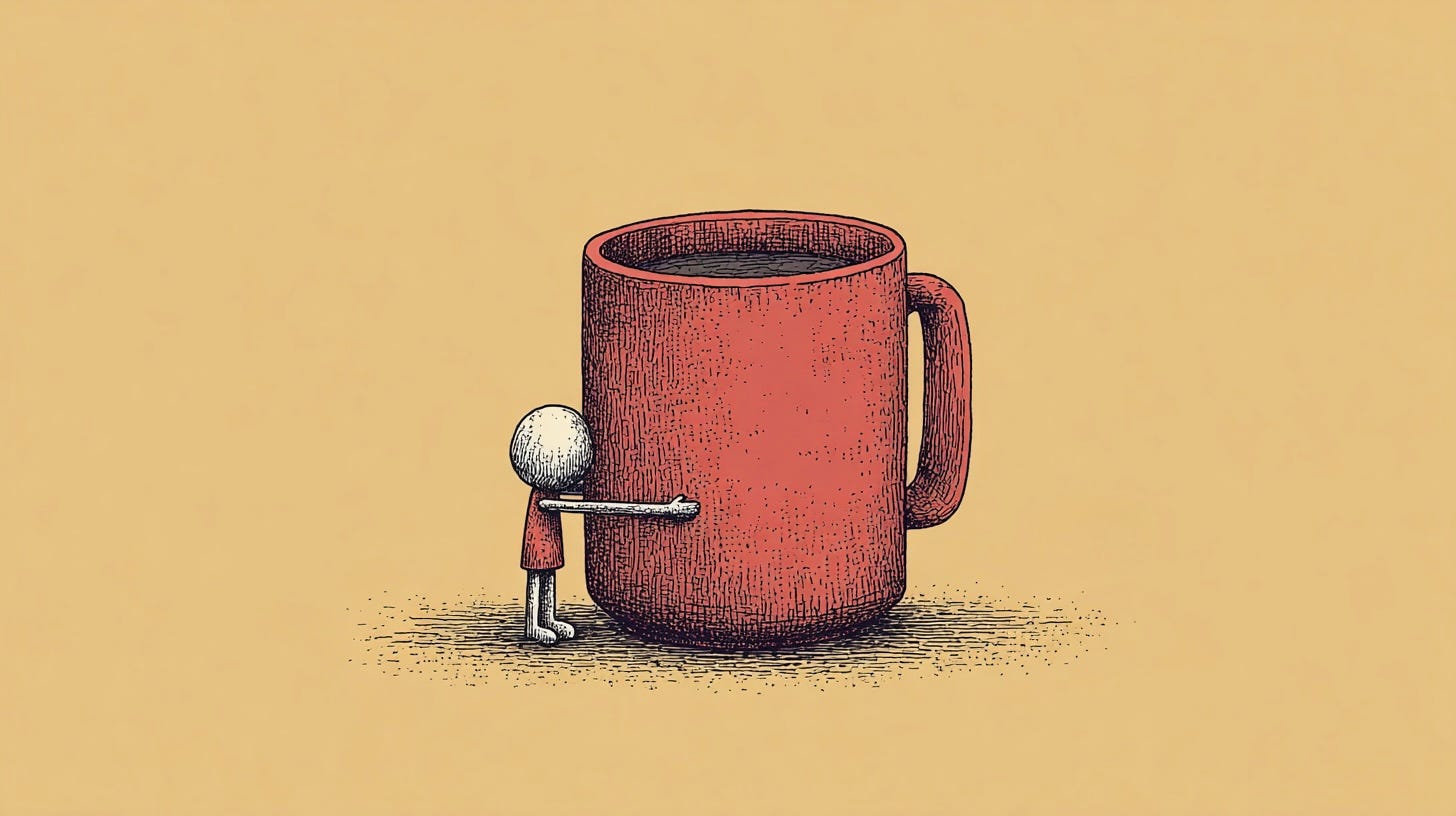
In an experiment published in 1990, researchers handed identical mugs to half a classroom and left the other half with nothing. They asked the new owners for the lowest price they would sell at, and asked everyone else for the highest price they would pay. The owners wanted roughly double what the others were willing to pay for the same mug they had been holding for a few minutes. This is the Endowment Effect. We price a thing higher the moment it becomes ours.
Nobody is losing sleep over a mug. It is the car you will not sell for what it is actually worth, because your years are in it. The spare phone in the drawer that nobody will pay what you think it is worth. The clothes filling the wardrobe unworn, the plans you keep defending because they are your plans. Letting go is priced as a loss even when holding on is the loss.
I still do this, and I know I am doing it while I am doing it, which does not stop it. There are things that have travelled through every move I have made, an old gadget that stopped working years ago, a box I have carried between three homes without opening, drafts of ideas I am never going back to. Every few months I decide to clear them out. I get as far as holding the thing, and all of a sudden I feel the price of the item increased, and I put it back down and tell myself I will deal with it later. I have never once missed anything I actually managed to give away. I still cannot make that fact change what happens when the object is in my hand. I am not keeping these things. I am storing them so I never have to price them.
Then a single verse repriced everything I own.
مَا عِندَكُمْ يَنفَدُ ۖ وَمَا عِندَ ٱللَّهِ بَاقٍۢ ۗ وَلَنَجْزِيَنَّ ٱلَّذِينَ صَبَرُوٓا۟ أَجْرَهُم بِأَحْسَنِ مَا كَانُوا۟ يَعْمَلُونَ
“Whatever you have will end, but what Allah has is lasting. And We will surely give those who were patient their reward according to the best of what they used to do.” (Surah An-Nahl, 16:96)
Whatever you have will end. The verse is speaking wider than mugs and wardrobes, but the principle lands on exactly what the Endowment Effect inflates. What is with you, what is in your hand, is expiring. You are paying a premium for the temporary because you are the one holding it, while what is with Allah is the only holding that does not run out. And the verse does not stop at the diagnosis. It attaches the reward to patience, the willingness to carry a loss you feel now for something you cannot yet see.
Then a hadith, a recorded saying of the Prophet ﷺ, runs the audit line by line. He was reciting Surah At-Takathur, the chapter of the Quran on being diverted by the pursuit of more, when he said:
“The son of Adam claims: My wealth, my wealth. And he (the Holy Prophet) said: O son of Adam. Is there anything as your belonging except that which you consumed, which you utilised, or which you wore and then it was worn out or you gave as charity and sent it forward?” (Sahih Muslim 2958a)
Run the audit on everything you call yours. Three categories pass it. What you ate is gone. What you wore is worn out. And what you gave is sent forward. Two of those are already spent. Only the third is still working for you. Everything else, the full storage room, the portfolio, the box that has moved house three times, sits outside what the hadith is willing to call yours. It is inventory you are guarding for whoever gets it next. Owning things is not the problem. Eating and wearing are two of the three categories. What fails the audit is the thing you hold for no reason except that you hold it.
And notice which category the hadith crowns. The Endowment Effect prices giving as the ultimate loss, handing the thing over exactly when you value it most. The hadith inverts the ledger, the given thing is the only thing you keep. Sadaqah, charity given without expecting anything back, is not framed here as generosity, it is framed as the only use of wealth in which the wealth is still yours afterwards. Loss aversion says letting go is losing. Throwing it away is also letting go, and it counts for nothing. The hadith names one release that is not a loss. Give it in charity, and it is still yours.
The mug is worth the same in every hand. You were never pricing the mug. You were pricing the letting go. And the one release you were least willing to make is the only one that would have kept it.
Something to do: Pick one thing you own that you have not used in a year but someone else would actually want, and give it to a person or cause today.
Something to think about: How much of what you are holding are you holding only because it is already in your hand?
Quran translations: Sahih International. Hadith translations: Sunnah.com.