

1400 | Issue #20
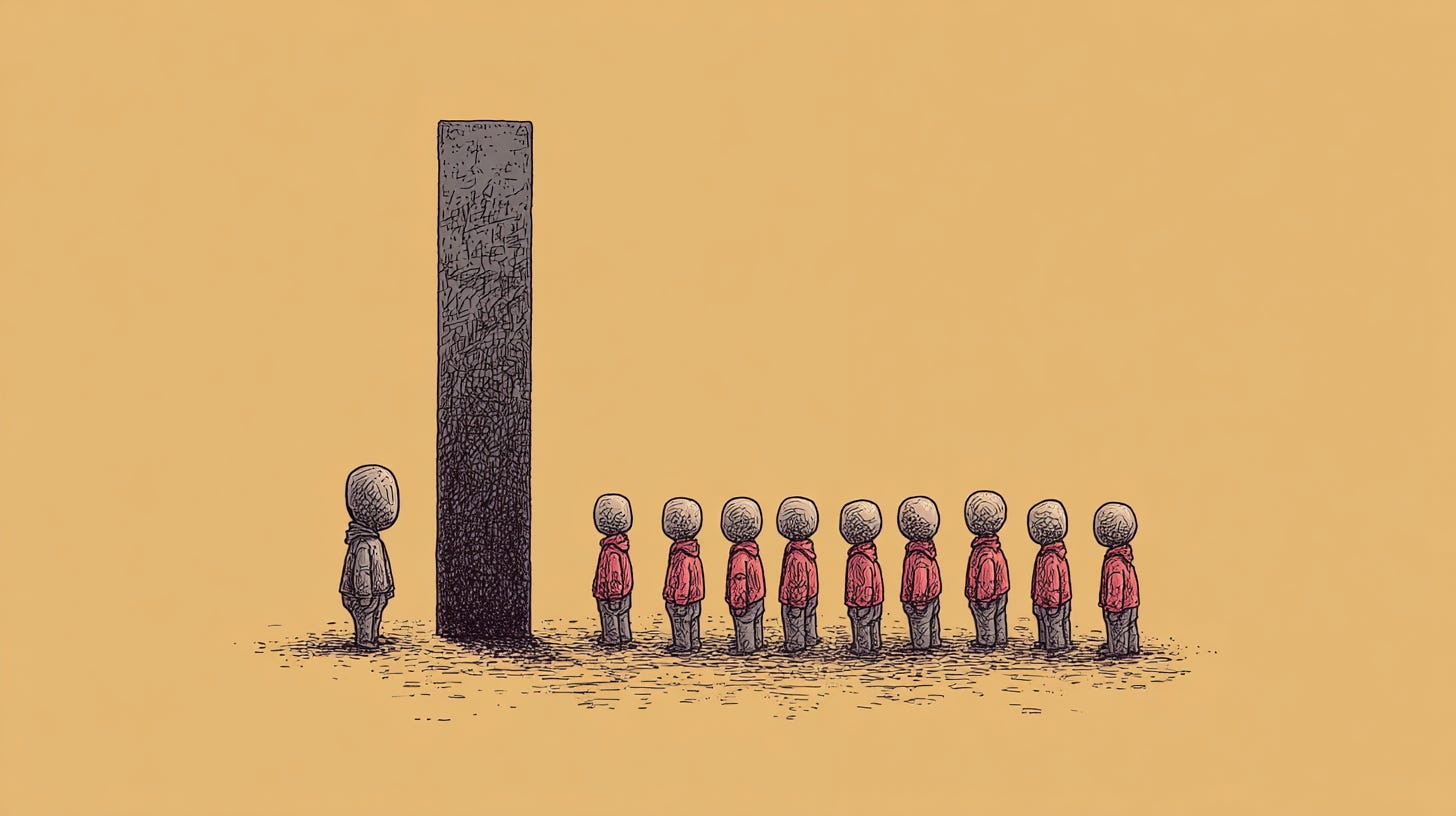
In 1951 a study was done where a psychologist sat people down for what seemed to be a vision test. He showed them two cards, one with a single line, and one with three lines of different lengths, and asked which of the three matched the first. The answer was obvious. Everyone else in the room was an actor, and when they were asked to answer, they all gave the same wrong answer confidently, one after another. When it was the real participant’s turn, three out of four went along with the group at least once and denied what they could plainly see, just because the room saw otherwise.
Most of them knew the answer was wrong. They said it anyway. And once enough people say a thing out loud, the next person stops checking and simply believes it. That is the Bandwagon Fallacy. Everyone believes it, so it must be true. Everyone is doing it, so it must be fine.
For years, I carried this into the gym. There are a lot of myths in there, and nobody questions them because everybody repeats them. We used to believe that soreness meant progress, we believed in spot reduction where crunches and sit-ups could target belly fat, we believed that eating after 8pm made you fat. I learned these things in the gym, I confidently taught them to other people, and I never once checked. Then I took a personal training course that covers exercise physiology and nutrition, and found out that dozens of the things I had been repeating were myths. Some of them had been disproven decades before I ever opened my mouth.
A verse revealed over 1400 years ago counted the crowd and rejected the math.
وَإِن تُطِعْ أَكْثَرَ مَن فِى ٱلْأَرْضِ يُضِلُّوكَ عَن سَبِيلِ ٱللَّهِ ۚ إِن يَتَّبِعُونَ إِلَّا ٱلظَّنَّ وَإِنْ هُمْ إِلَّا يَخْرُصُونَ
“And if you obey most of those upon the earth, they will mislead you from the way of Allah. They follow not except assumption, and they are not but misjudging.” (Surah Al-An’am, 6:116)
Look at the diagnosis inside the warning. The problem with the majority is not that it is a majority. It is that the majority are running on assumption. The participant in that room never asked what the crowd was running on. He heard the count and stopped there, which is the whole move. The verse ties the two together. Being astray and running on guesswork are not two separate problems. A million people guessing still only produces a very loud guess.
A hadith, a recorded saying of the Prophet ﷺ, warned that the Muslims would end up walking the same paths as the communities before them, and described the pull with an image that has not aged a day:
“You will follow the ways of those nations who were before you, span by span and cubit by cubit (i.e., inch by inch) so much so that even if they entered a hole of a mastigure, you would follow them.” (Sahih Al-Bukhari 7320)
Span by span. Not one dramatic surrender but a thousand small alignments, each too minor to notice, until the destination is somewhere no one would have chosen from a standing start. The hadith even supplies the absurd endpoint, a lizard’s burrow, a place with nothing in it, entered for no reason except that the ones ahead went in.
Then the Quran closes the escape route the crowd seems to offer, the comfort of shared responsibility:
وَلَا تَقْفُ مَا لَيْسَ لَكَ بِهِۦ عِلْمٌ ۚ إِنَّ ٱلسَّمْعَ وَٱلْبَصَرَ وَٱلْفُؤَادَ كُلُّ أُو۟لَـٰٓئِكَ كَانَ عَنْهُ مَسْـُٔولًۭا
“And do not pursue that of which you have no knowledge. Indeed, the hearing, the sight and the heart - about all those [one] will be questioned.” (Surah Al-Isra, 17:36)
Your hearing, your sight, your heart. Each questioned, each answering alone. There is no clause for “everyone else believed it too.” The crowd that carried you to the belief will not be answering for it. The antidote is to refuse to let a headcount stand in for a reason. The account is individual, and the number of people who agree with you is not part of it.
A million people believing a thing will add nothing to whether it is true. It only changes how it feels to doubt it.
Something to do: Take one opinion you are sure of and try to state the evidence for it without mentioning a single person who agrees with you.
Something to think about: Which of your convictions would survive if you were the only one left holding it?
Quran translations: Sahih International. Hadith translations: Sunnah.com.